Categories
Uncategorized

What 5,247 Hiring Managers Said About Why People Get Hired

Updated May 2026.

The short version: Leadership IQ surveyed 5,247 hiring managers. 89% of new-hire failures came down to attitude — motivation, coachability, self-awareness, fit. Only 11% came down to skill. If you’re being told “no” after final rounds, you’re losing on the 89% nobody writes on the job posting. This article shows what the 89% actually is, why most candidates miss it, and the one thing to do this week to fix it.

The CEO of Greenhouse — the company whose software runs the recruiter inbox at most of the Fortune 500 — said something out loud last year that the hiring industry had been quietly thinking. He said there are over 400 applications sitting in the average recruiter’s inbox at any given time, and that those recruiters “can’t really tell which ones we should pay attention to.”

If you’ve been applying and hearing nothing back, that quote will land like a kick to the gut. But the kick lands differently once you see the next number — because what hiring managers do pay attention to, when they finally pay attention, is not the thing you’ve been told to optimize for.

The Number Most Career Advice Avoids

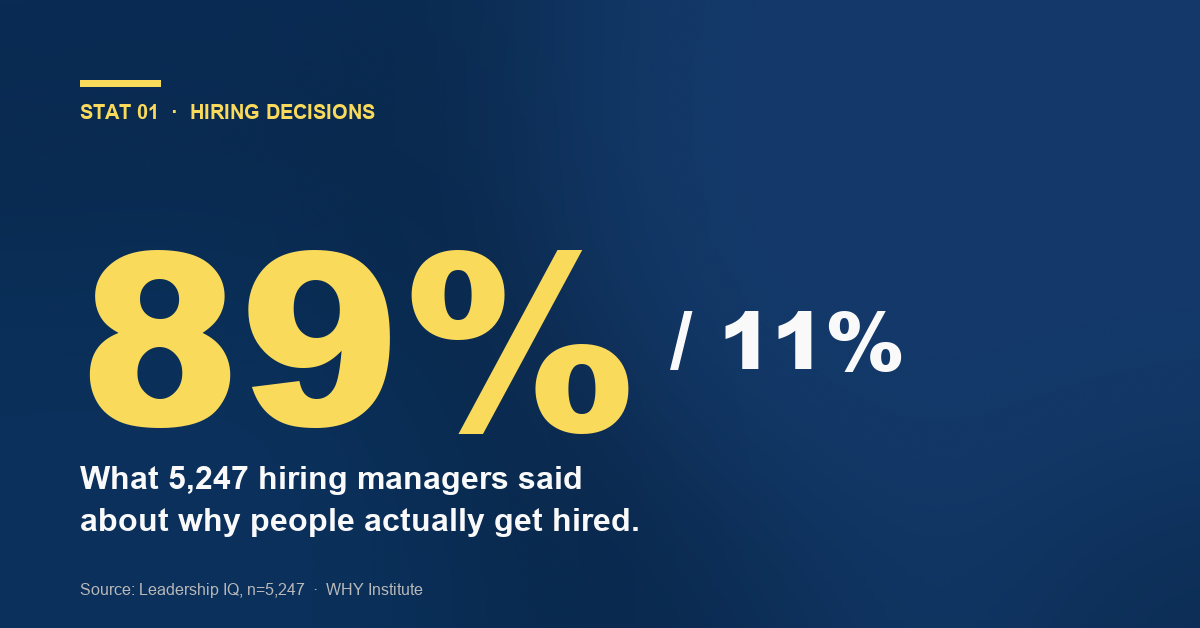
Leadership IQ — a research firm that studies workplace performance — ran a study on why new hires fail. They surveyed 5,247 hiring managers across 312 organizations. They asked one direct question: when a new hire doesn’t work out, what was the reason?
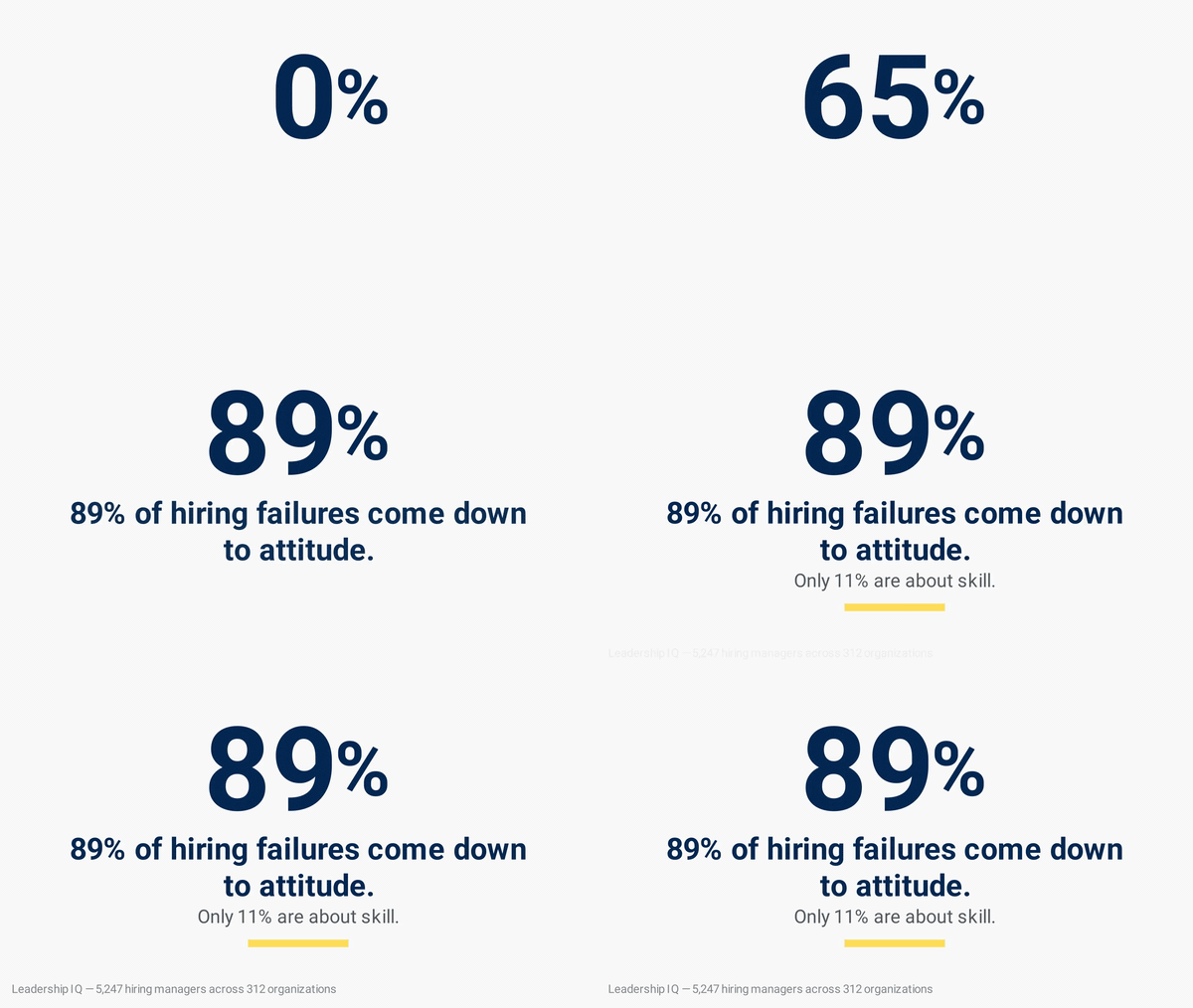
Animated stat: 89% of hiring failures come down to attitude — only 11% are about skill (Leadership IQ).

Here’s the breakdown they reported:

  • 89% of new-hire failures came down to attitude. Motivation. Fit. Self-awareness. Coachability. The way the person showed up.
  • 11% came down to a lack of technical skill.

The thing companies say they hire for is not the thing they actually hire for. They say “five years’ experience.” They mean “do I want to sit next to this person at 11pm during a launch.”

Sit with that ratio for a second. Because every job posting you have ever read leads with skill. Five years of this. Certified in that. Proficient in the other thing. That language describes 11% of the hiring decision. The other 89% — the part that actually decides who gets the offer — is almost never named on the page.

So when you see “qualified candidates only” and you check every box and you still don’t get the call, you’re not going crazy. You’re answering the question on the posting. They’re scoring the question they didn’t write down.

What “Attitude” Actually Means

“Attitude” is a soft word for what’s actually a hard, specific thing. When Leadership IQ unpacked the 89%, four things kept showing up in the data: motivation (does this person want this work for the right reasons), coachability (can they take feedback without breaking), emotional intelligence (do they read the room), and temperament (do they fit the actual day-to-day).

All four trace back to one underlying capacity: self-knowledge.

And here’s where the data gets sharper. Tasha Eurich, the organizational psychologist, ran a separate research project for Harvard Business Review with more than 5,000 participants. She found that 95% of professionals believe they’re self-aware. Only 10–15% actually meet the criteria.

So you have an 89% hiring decision built on a trait that 85–90% of the workforce thinks they have and doesn’t. The candidate who walks in with real, articulated self-knowledge is not just a slightly better candidate. They are statistically rare. They are the 10–15% in a stack of pattern-matched lookalikes — and the hiring manager feels it the moment they sit down.

This is what hiring managers mean when they say things like “we just clicked” or “she was the one.” It isn’t chemistry. It’s signal. They are picking up on a candidate who knows exactly who they are and what they’re doing in the room — and they are picking that candidate over candidates who, on paper, look the same.

A Real Final-Round Pattern: The Two Maria Problem

Here’s a composite from the kind of final-round we hear about constantly. Two candidates make it to the last round for a senior product manager role. Call them Maria A and Maria B. On paper they are identical: same MBA, same six years of experience, same shipped products on their resume.

Maria A is technically the stronger candidate. Her case study deliverable is tighter. Her metrics are sharper. The hiring panel agrees she is the more “qualified” of the two on every measurable axis. The 11%.

Maria B is asked, in the final round, why this role and why now. She answers in one breath. She says, in plain language, that she is hardwired to figure things out — to take an ambiguous brief and turn it into a clear plan — and that this role, which is rebuilding a broken roadmap, is exactly that work. She names how she operates with teammates. She names what she contributes that nobody asks her to. She does not hedge. She does not list adjectives.

Maria A answers the same question with a polished narrative about her career path and what she has learned from each role. It is well-rehearsed. It is also indistinguishable from the answer the panel heard from the previous three finalists.

Maria B gets the offer. The hiring manager later told her recruiter: “She just sounded like she knew exactly who she was.” That is the 89%. Maria A had the skill. Maria B had the signal.

How This Shows Up in the Final Round

If the 89% is the rule, the final round is where the rule breaks the tie.

By the time two candidates are sitting in a final interview, they’re both qualified. They both have the experience. The decision is no longer about credentials — it can’t be, because both finalists have them. The decision is about which candidate makes the hiring manager feel certain.

And the question that decision turns on is almost always the same one: Why this role, and why now?

Eight in ten hiring managers say candidates with genuine drive outperform candidates who are slightly more qualified but less clear about their motivation. Read that sentence carefully. Slightly more qualified. Less clear. The slightly-more-qualified candidate loses. The clearer candidate wins.

If you’ve ever been in a final round and walked out with a strong feeling and no offer, this is almost always what happened. You answered the qualification questions. You didn’t answer the 89% question. (We broke down the final-round dynamic in more detail in The Confidence Heuristic: How Hiring Managers Decide in 15 Minutes.)

What to Do This Week

Most career advice in 2026 is still advice for the 11%. Polish your resume. Add the right keywords. Practice your STAR stories. All of that is fine — and none of it touches the 89% that’s actually deciding the outcome.

The 89% requires something different. It requires you to be able to articulate, in plain language, what drives you, how you operate, and what you contribute — with enough certainty that a hiring manager hears you and stops looking at the rest of the stack.

That isn’t a confidence trick. You can’t fake your way to it, and rehearsing buzzwords makes it worse. It’s the byproduct of self-knowledge — the kind that 10–15% of professionals actually have. The good news: it isn’t a personality trait you were either born with or not. It’s the result of a specific framework, applied to yourself, in writing, until it’s clear enough to say in one breath.

Here is a five-step exercise you can run this week, before your next final round:

  1. Write your WHY in one sentence. Not your job. Not your title. The thing you are hardwired to do — the contribution that shows up across every role you’ve ever held. Most people need three drafts before this lands honestly.
  2. Write your HOW in one sentence. The way you operate when you’re at your best. Not adjectives — verbs. “I find the simplest version of the problem and put words on it” is a HOW. “I’m a hard worker” is not.
  3. Write your WHAT in one sentence. The specific contribution other people count on you for. The thing colleagues come to your desk for that nobody asked you to be the person for.
  4. Read all three out loud. If any of them sound like a LinkedIn headline, rewrite. Hiring managers can hear rehearsed language. They cannot hear self-knowledge in language that was built to be impressive.
  5. Practice the answer to “Why this role and why now” using only those three sentences. No biographical narrative. No career-path summary. Just: this is what I’m hardwired to do, this is how I do it, this is what people count on me for, and this role is exactly that work.

If you can do that exercise honestly in a notebook, you will walk into your next final round answering the 89% question — the one nobody else in the stack is answering — in a way that is impossible to fake and impossible to forget.

That is what the Career Clarity Pack does, in a structured framework, in one sitting. It walks you through the WHY.os — your hardwired driver, the way you operate, and what people count on you for — and gives you the language for the 89% the same way a good resume gives you the language for the 11%. One framework. One sitting. One clear answer to the question every hiring manager is silently asking and rarely writes down.

If you’ve been studying the 11% and losing on the 89%, the fix is not more polish. It’s clarity.

Get the $47 Career Clarity Pack →

Frequently Asked Questions

What did the Leadership IQ study actually find?

Leadership IQ surveyed 5,247 hiring managers across 312 organizations and tracked over 20,000 new hires. They found that 46% of new hires fail within 18 months — and when they do, 89% of those failures trace back to attitude (motivation, coachability, emotional intelligence, temperament), not technical skill. Skill accounts for only 11%.

Why does attitude matter more than skill in hiring?

Skill is easy to verify on a resume — and easy to train once a person is hired. Attitude is hard to assess in 30 minutes and almost impossible to train later. So hiring managers, often without saying it out loud, weight the harder-to-fix variable. The candidate with clear self-knowledge becomes the safer bet, even when their resume is slightly less polished.

How do hiring managers test for coachability?

They watch how you respond to pushback in the room. When an interviewer challenges your answer or surfaces a weak spot, do you defend, deflect, or absorb the feedback and respond clearly? Candidates who can name what they don’t know — without losing certainty about who they are — signal coachability without having to claim it.

What is the WHY.os and how does it relate to hiring?

The WHY.os is your operating system: your WHY (what drives you), your HOW (how you operate at your best), and your WHAT (what you contribute that people count on you for). All three are drawn from the 9 WHYs framework. Together they give you the precise, plain-language answer to the question every hiring manager is silently asking — and almost no candidate answers clearly.

How do I find my WHY?

The fastest evidence-based path is the WHY.os Discovery inside the Career Clarity Pack — a structured framework that surfaces your hardwired driver, your operating style, and your contribution in one sitting. It is research-backed and used by over 250,000 people. You can also start with the five-step exercise above as a free first pass.
Categories
Uncategorized

The Confidence Heuristic: How Interviewers Decide in 15 Min

Updated May 2026 with peer-reviewed sources linked inline.

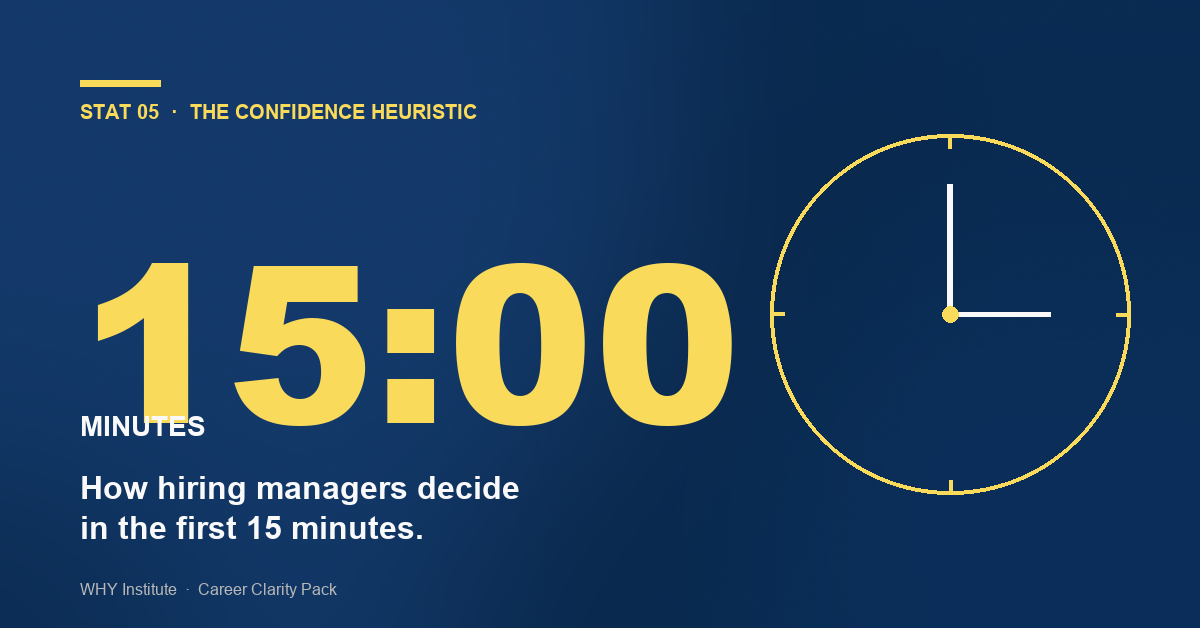
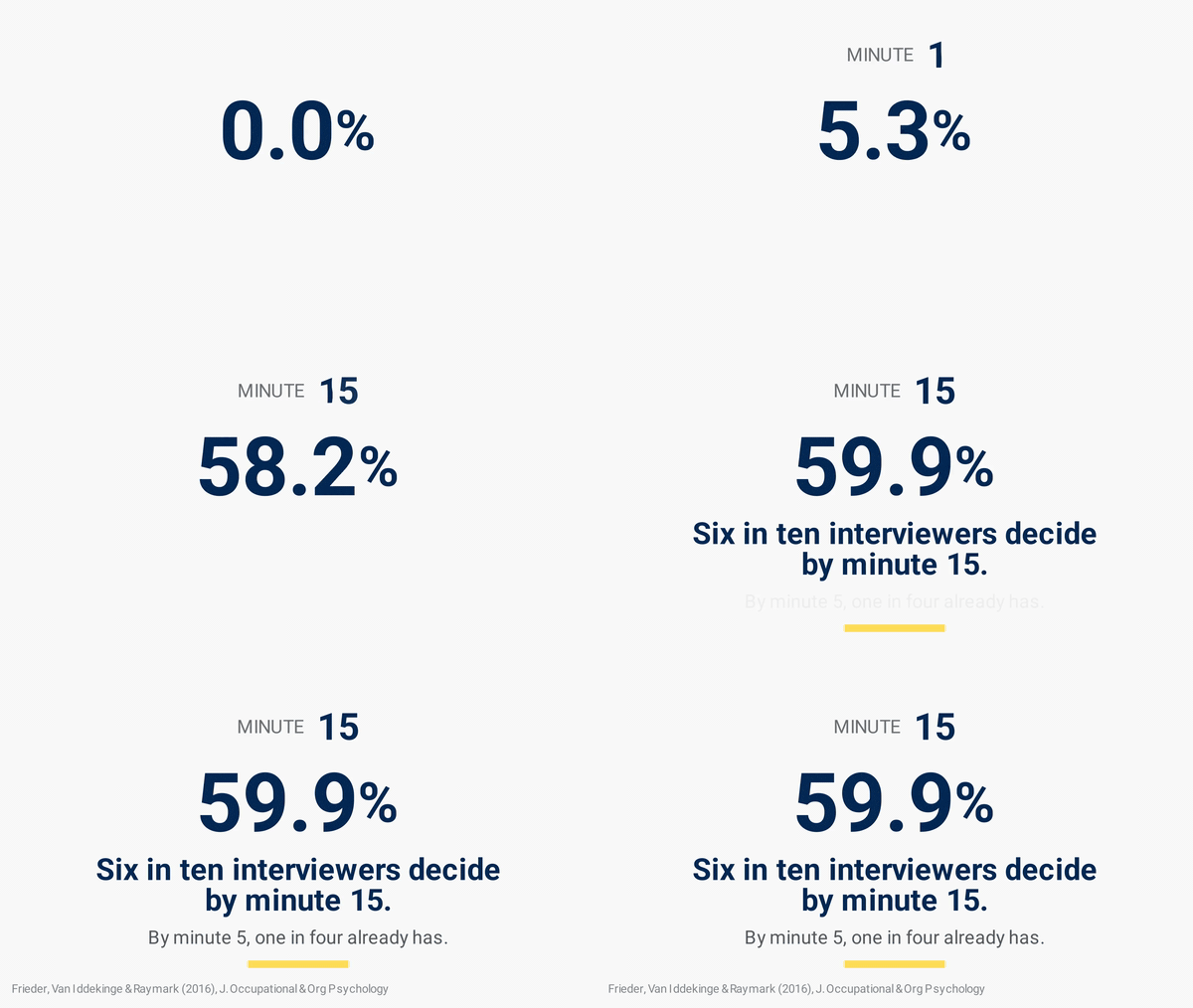
Six in ten interviewers have already decided about you before the halfway mark of your interview. Not minute thirty. Not the technical round. Minute fifteen.

That number comes from a peer-reviewed study by Frieder, Van Iddekinge, and Raymark (2016) — 166 interviewers evaluating 691 real candidates, published in the Journal of Occupational and Organizational Psychology. The breakdown is sharper than the headline:

  • 4.9% of interviewers reach a decision within the first minute.
  • 25.5% have decided within the first five minutes.
  • 59.9% — six in ten — have decided by minute fifteen.
Animated stat: 4.9% at minute 1, 25.5% at minute 5, 59.9% at minute 15 of interviews — six in ten decide by 15.

Most of the candidates in that study were still answering their second or third question when the person across the desk had already made up their mind. Whatever you say about who you are inside those fifteen minutes is what gets graded. The rest of the interview is the hiring manager looking for evidence to confirm what they already think.

The Stat Career Coaches Get Wrong

You have probably heard a different version of this number. The “seven-second first impression.” The “ninety-second decision.” Those numbers get repeated in every LinkedIn post, every interview-prep article, every TikTok career coach reel.

The seven-second number does not trace to a peer-reviewed interview study. It traces to social-perception research from the 1990s — Ambady and Rosenthal’s “thin slice” work — that was about classroom evaluations of teachers, not interview decisions for jobs. Over twenty years it got generalized, then over-generalized, then converted into clickbait. The ninety-second number has a similar problem. Neither one survives a citation check.

The Frieder, Van Iddekinge, and Raymark data does. It is the cleanest peer-reviewed measurement we have of when actual hiring interviewers reach a decision in actual interviews. And the answer it gives is not seven seconds. It is fifteen minutes.

That distinction matters because it changes what you can do about it. Seven seconds is a verdict. Fifteen minutes is a conversation. Fifteen minutes is enough time to say something true about who you are. Most candidates do not. (Related reading: what 5,247 hiring managers said they actually screen for.)

What Actually Decides It in Minute 15

If the decision is made before the technical round, before the deep-dive questions, before the case study — then it isn’t being made on competence. It is being made on something else. Researchers have a name for it.

It is called the confidence heuristic. In a series of three experiments published in the Journal of Experimental Psychology: General in 2018, Pulford and colleagues showed that when two people communicate, the one who sounds more certain wins — and that listeners use certainty as a shortcut for accuracy. The effect held in face-to-face conversations and in computer-mediated ones, which means it isn’t body language doing the work. It is the verbal expression of certainty itself. The candidate who sounds sure of who they are is read as the candidate who knows more.

The Pulford finding is not just an interview phenomenon. Stanford Graduate School of Business research has examined the same pattern from a different angle: how brittle first impressions are once formed, and how confidence — not competence — drives whether the impression sticks. Jerker Denrell’s work at Stanford GSB shows that once a hiring manager has read a candidate as uncertain, that read is unusually hard to reverse — there is rarely a second chance to clarify it inside the same interview.

The interview is not a competence test. It is a confidence test — and most of what’s being graded happens before the competence questions even start.

That is the brutal version of the answer. The interview is not measuring who can do the job. It is measuring who can talk about doing the job without flinching. And by minute fifteen, the hiring manager has already decided whether you can.

The Difference Between Confidence and Certainty

This is where most career advice gets dangerous. The advice industry hears “candidates with confidence win” and converts it into performance — power poses, eye contact drills, vocal warm-ups, the firm handshake. All of that lives on the surface. None of it survives fifteen minutes of an interviewer paying close attention.

Performed confidence and grounded certainty are not the same thing. They sound different on contact. Performed confidence is loud and slightly forced — the candidate is auditioning. Grounded certainty is quieter — the candidate is already at home in who they are. The interviewer cannot always tell you which one is which, but they can feel it. Selection-interview research published in the Journal of Business and Psychology consistently shows the same pattern: candidates who register as authentic — not rehearsed — are rated higher in the interview and perform better on the job afterward. Authenticity tracks reality. Performance does not.

The reason is mechanical, not mystical. Certainty is hardwired. It comes from knowing the thing about yourself that has been true since you were a kid — the way you process the world, the reason you do the work the way you do it, the signal that runs underneath every choice you’ve ever made. You don’t manufacture that in a coaching session. You uncover it. And once it’s named, it’s stable. It doesn’t shake under pressure. That is what an interviewer is reading in the first fifteen minutes — whether the person across from them is operating from something solid, or assembling an answer in real time.

This is the lane the WHY framework lives in. A WHY is not a polished story. It is the underlying driver — one of nine — that has been running you the whole time. Once you know which one it is and how it expresses itself, the certainty isn’t performance. It’s recognition.

How to Sound Certain Without Sounding Rehearsed

Practical things you can do, knowing what the research actually says — but only after the underneath part is in place. None of these tactics work unless you have the self-knowledge to anchor them.

  • Lead with why, not where. When the interviewer asks “tell me about yourself,” most candidates start chronologically — school, first job, second job, here. That is the language of credentials. Replace the chronology with a one-sentence statement of why you do the work the way you do it, then let the chronology serve the why. The hiring manager is grading whether you have a center. Show them the center first.
  • Cut the qualifiers. “I think I’m pretty good at…” “I sort of see myself as…” “I feel like maybe I…” Hedging language is the verbal opposite of certainty. The Pulford research is specifically about verbal expressions of confidence. Every “I think” you remove makes the room read you as more sure.
  • Answer “why this role” the way the recruiter is actually asking it. The question is not “do you like the job description.” It is “do you know why this work, specifically, sits inside who you are.” Most candidates answer the first question. The candidate who answers the second one is the one the room remembers in minute fifteen.
  • Stop sounding like a candidate. The candidate voice — modest, qualifying, eager to please — is the voice of a person hoping to be chosen. The voice that wins the room is the voice of a person who has already made the decision about who they are, and is now describing it. The shift is subtle. It is also the entire signal.

None of these tactics are about volume or polish. They are about source. You can rehearse a confident answer, and an experienced interviewer will hear the rehearsal. You cannot rehearse certainty about who you are. That has to actually be there.

The One Thing the First Fifteen Minutes Is Really Grading

Strip everything else away and the question the hiring manager is asking in those first fifteen minutes is one question: does this person know who they are?

Not what they did. Not where they went to school. Not how many years they have. Whether they know themselves clearly enough to describe themselves without flinching, in their own language, with conviction. That is the signal hiring managers are filtering on, even when they cannot tell you that is what they are doing. The peer-reviewed research is unambiguous about it. The candidates who walk in with that signal — grounded, articulate, certain — are the ones who walk out with offers.

The reason most candidates can’t do this isn’t talent or preparation. It is that nobody has ever taught them to articulate what is already true. Their resume is built. Their LinkedIn is optimized. Their interview answers are rehearsed. But the question underneath all of it — who am I, and why do I do the work the way I do it — has never been answered in language they can use in a room.

That is exactly the gap the WHY.os closes. It is not a personality test. It is a system that names the three layers of how you operate — your core driver, the way you bring it into the world, and the impact people feel from being around you. It produces the language a hiring manager hears in minute fifteen and remembers in minute fifteen-thousand. Not a story you wrote. A signal that was already there.

If you have ever walked out of a final round wondering what they saw — or didn’t see — in those first fifteen minutes, this is what was missing.

Frequently Asked Questions

How quickly do interviewers really decide?

Peer-reviewed research from Frieder, Van Iddekinge, and Raymark (2016) tracking 166 interviewers across 691 real candidates found 4.9% decide within minute one, 25.5% within five minutes, and 59.9% — nearly six in ten — by minute fifteen. The “seven-second” stat from viral career advice does not trace to interview research; it traces to 1990s thin-slice studies of classroom teachers.

What is the confidence heuristic?

The confidence heuristic is a documented pattern, tested in Journal of Experimental Psychology: General by Pulford et al. (2018), where listeners use a speaker’s certainty as a shortcut for accuracy. The person who sounds more sure gets read as the person who knows more — even when they don’t. In interviews, this means the candidate whose self-description carries certainty is graded as more competent, regardless of credentials.

How do I sound confident without being rehearsed?

Drop hedging language (“I think,” “I sort of,” “I feel like maybe”). Lead with why you do the work, not where you’ve worked. Answer “why this role” by naming the part of who you are that the work satisfies, not by describing the job. None of these tactics work without the self-knowledge underneath them — rehearsal is detectable inside fifteen minutes of an attentive interviewer.

What does authenticity look like in an interview?

Authenticity in an interview is the verbal version of self-knowledge. It sounds like a person describing something they already know, not a person reaching for an answer. Selection-interview research in the Journal of Business and Psychology consistently links authenticity ratings to higher interview scores AND higher post-hire job performance. It tracks reality; performed confidence does not.

How does the WHY.os help with interview confidence?

The WHY.os names the three hardwired layers of how you operate — your core driver, the way you bring it into the world, and the impact people feel from being around you. It gives you the language an interviewer hears as certainty in minute fifteen, because it isn’t a story you wrote — it’s a signal that was already there. The Career Clarity Pack ($47) is the fastest path to that language.

Get the Career Clarity Pack — $47

Categories
WHY.os

Should You Tailor Your Resume With AI in 2026? What Actually Gets You Hired Now

A recruiter I respect said this on a podcast last month: “Every candidate looks like the perfect candidate now. The signal is gone. We’re drowning in resumes that all sound the same.”

Then a hiring manager friend told me the opposite. She said if your resume isn’t tailored to the keywords in the job post, her software filters it out before any human ever sees it.

Both are right. And that’s the trap.

Tailor your resume too much with AI and you sound like everyone else. Don’t tailor it at all and you never make the first cut. So what is a real job seeker actually supposed to do in 2026?

The Data: Tailoring With Keywords Is Not Optional

Let’s start with the part most people get wrong. They’ve heard “ATS rejects 75% of resumes.” That stat traces back to a sales pitch from 2012. Ignore it.

Here’s what’s actually true in 2026.

According to Jobscan’s State of the Job Search 2025 report, 99.7% of recruiters now use ATS filters. 98.4% of Fortune 500 companies use one. If you’re applying to a real company, your resume is being scanned by software before any human reads a single word.

And the software has clear preferences. 76.4% of recruiters filter by skills first. 55.3% filter by job titles. 50.6% filter by certifications. Match those and you move forward. Miss them and you don’t.

The single biggest lever? Match the job title.

Jobscan’s research found that candidates whose resume job title matches the listing get interviews 10.6 times more often than candidates with a mismatched title. That’s not a tweak. That’s the difference between getting a callback and never hearing back.

So yes, you do need to tailor. You need the right keywords, the right skills language, and a job title on your resume that mirrors the one on the post. This is table stakes now.

But Here’s the Catch

If everyone is tailoring with AI, and 51% of job seekers admit they’ve used ChatGPT to write a resume (per a ResumeBuilder.com survey of 1,000 job seekers), what happens to the pile?

It looks the same. All of it.

Recruiters notice. The Resume-Now AI Applicant Report (March 2025) surveyed 1,000+ hiring managers and found:

  • 74% have personally encountered AI-generated content in applications.
  • 62% are more likely to reject AI-generated resumes that lack personalization.
  • 33.5% say they can spot an AI resume in under 20 seconds.
  • 80% reject AI resumes that read robotic.

You can read the full Resume-Now report on hiring managers rejecting AI-generated resumes without personalization for the methodology.

The volume problem is just as bad. LinkedIn now sees about 11,000 application submissions per minute, with overall application volume up 45% year-over-year — much of it driven by AI auto-apply tools. North of the border it’s worse: a Globe and Mail story on Canadian hiring managers saying AI resumes are slowing them down reports that 61% of Canadian hiring managers say AI resumes are slowing hiring, and 89% say their workloads have spiked.

One recruiter quoted in Inc.’s reporting on how every resume looks the same put it bluntly: “Every candidate looks like the perfect candidate, so the noise just shot through the roof and the signal that I was trying so hard to find is even more elusive.”

Then there’s the dirty secret. About 41% of U.S. job seekers admit to hiding prompt-injection text in their resumes — invisible white text designed to trick AI screeners. ManpowerGroup is now flagging hidden text in roughly 10% of scanned resumes. So even the “smart” tactics are getting caught.

Bonnie Dilber, the recruiting lead at Zapier, said something on HR Brew that stuck with me. She said she uses AI to give feedback on resumes, but she doesn’t let AI take over the things she’s uniquely positioned to do — especially on high-stakes work like job applications.

That’s the whole answer in one sentence. But let’s spell it out.

The Synthesized Answer

Here is what actually works in 2026.

Tailor your resume with AI for keywords and skills language. Lead every bullet with a specific, quantified, verifiable accomplishment that no AI could fabricate.

Two layers. They do different jobs.

Layer one: AI-assisted keyword tailoring

Paste the job post. Ask AI to extract the top 10 skills, the top 5 certifications, and the exact job title. Make sure those terms appear naturally in your resume. Match the job title at the top of your experience section if it’s truthful.

This is what gets you past the ATS. It’s also what every other applicant is doing. Don’t skip it. But know it only buys you the chance to be read.

Layer two: human-only substance

Once a human is reading, the resume has 20 seconds to prove you’re not a bot.

The way you do that is with bullets AI literally cannot make up. Numbers. Names of systems. Specific dollar amounts saved, customers retained, tickets resolved, deals closed. SHRM’s 2025 data on AI in recruiting shows resumes with quantified achievements get about 2.3x more callbacks. AI HR adoption itself jumped from 26% in 2024 to 43% in 2025 — meaning the bar for sounding human is moving up.

Bad bullet: “Drove growth through strategic initiatives that increased revenue.”

Good bullet: “Rebuilt the onboarding email sequence at a 40-person SaaS company; lifted trial-to-paid conversion from 6.1% to 9.4% in 90 days.”

The first one is what AI writes when it has nothing to work with. The second one is what you write when you actually did the thing.

Use AI as a polish layer. Let it tighten verbs and trim filler. Don’t let it invent the substance. The substance has to be yours.

The Deeper Problem No One Is Talking About

Here’s a question worth sitting with.

Why does every AI-tailored resume sound the same in the first place?

It’s not because AI is bad. AI is great at imitating patterns. The reason every AI-tailored resume reads like every other one is that the candidate gave the AI nothing real to work with. So the AI fills the empty space with the average. With words like “results-driven,” “passionate,” “strategic.” With language pulled from a million other resumes.

The blank page in the prompt becomes the blank page in the resume.

This isn’t really a resume problem. It’s a self-knowledge problem.

Most people can list what they did at their last job. Far fewer can tell you, in two sentences, why they did it that way and not another. What pulls them. What they consistently bring that no one else on the team brings. What they would do for free if money weren’t the question.

That’s the gap AI is filling for you. And it’s filling it with averages, because averages are all it has access to.

The WHY Angle

There’s a reason for this — and it’s wired into your brain.

The part of the brain that processes language and logic (the neocortex) is great at making lists of skills and dates. It’s the part that writes resumes. But the part that drives your actual decisions — the limbic brain — doesn’t have language. It has feelings, gut sense, and what we at WHY Institute call your WHY. Your core driver. The thing behind every decision you’ve ever made about your career, even the ones you can’t quite explain.

If you can’t put that driver into words, AI will do it for you. Badly. Generically. In language that sounds like everyone else.

If you can put it into words — if you know your specific WHY out of nine possible drivers — something interesting happens. Your bullets get sharper. Your stories get tighter. The “about me” line writes itself. The pull behind every job you’ve held becomes visible, and a hiring manager can feel it in twenty seconds.

Specifics plus stories plus your WHY equals language no AI can copy. Because the AI doesn’t know what moves you. Only you do. Once you do, the AI becomes useful again — as a polish layer over something real, not a generator of something fake.

This is the difference between a resume that survives the filter and one that gets a phone call.

Find Yours

If your resume reads like every other resume, the fix probably isn’t a better prompt. It’s clearer self-knowledge.

The free WHY.os Discovery from WHY Institute tells you which of nine drivers is yours, in under ten minutes. Tens of thousands of people have taken it. Once you know your WHY, your HOW, and your WHAT, your resume bullets stop sounding like AI wrote them — because the substance is finally yours.

Tailor with AI. Lead with the truth. When you know your WHY, you know your way.