Updated May 2026.
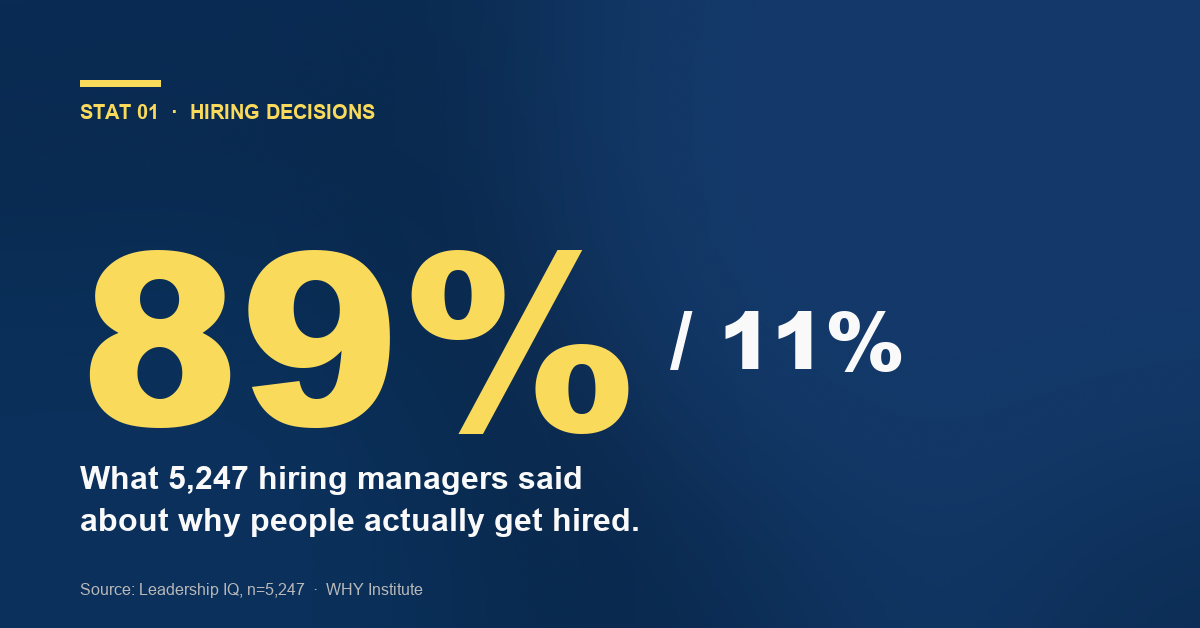
The short version: Leadership IQ surveyed 5,247 hiring managers. 89% of new-hire failures came down to attitude — motivation, coachability, self-awareness, fit. Only 11% came down to skill. If you’re being told “no” after final rounds, you’re losing on the 89% nobody writes on the job posting. This article shows what the 89% actually is, why most candidates miss it, and the one thing to do this week to fix it.
The CEO of Greenhouse — the company whose software runs the recruiter inbox at most of the Fortune 500 — said something out loud last year that the hiring industry had been quietly thinking. He said there are over 400 applications sitting in the average recruiter’s inbox at any given time, and that those recruiters “can’t really tell which ones we should pay attention to.”
If you’ve been applying and hearing nothing back, that quote will land like a kick to the gut. But the kick lands differently once you see the next number — because what hiring managers do pay attention to, when they finally pay attention, is not the thing you’ve been told to optimize for.
The Number Most Career Advice Avoids
Leadership IQ — a research firm that studies workplace performance — ran a study on why new hires fail. They surveyed 5,247 hiring managers across 312 organizations. They asked one direct question: when a new hire doesn’t work out, what was the reason?
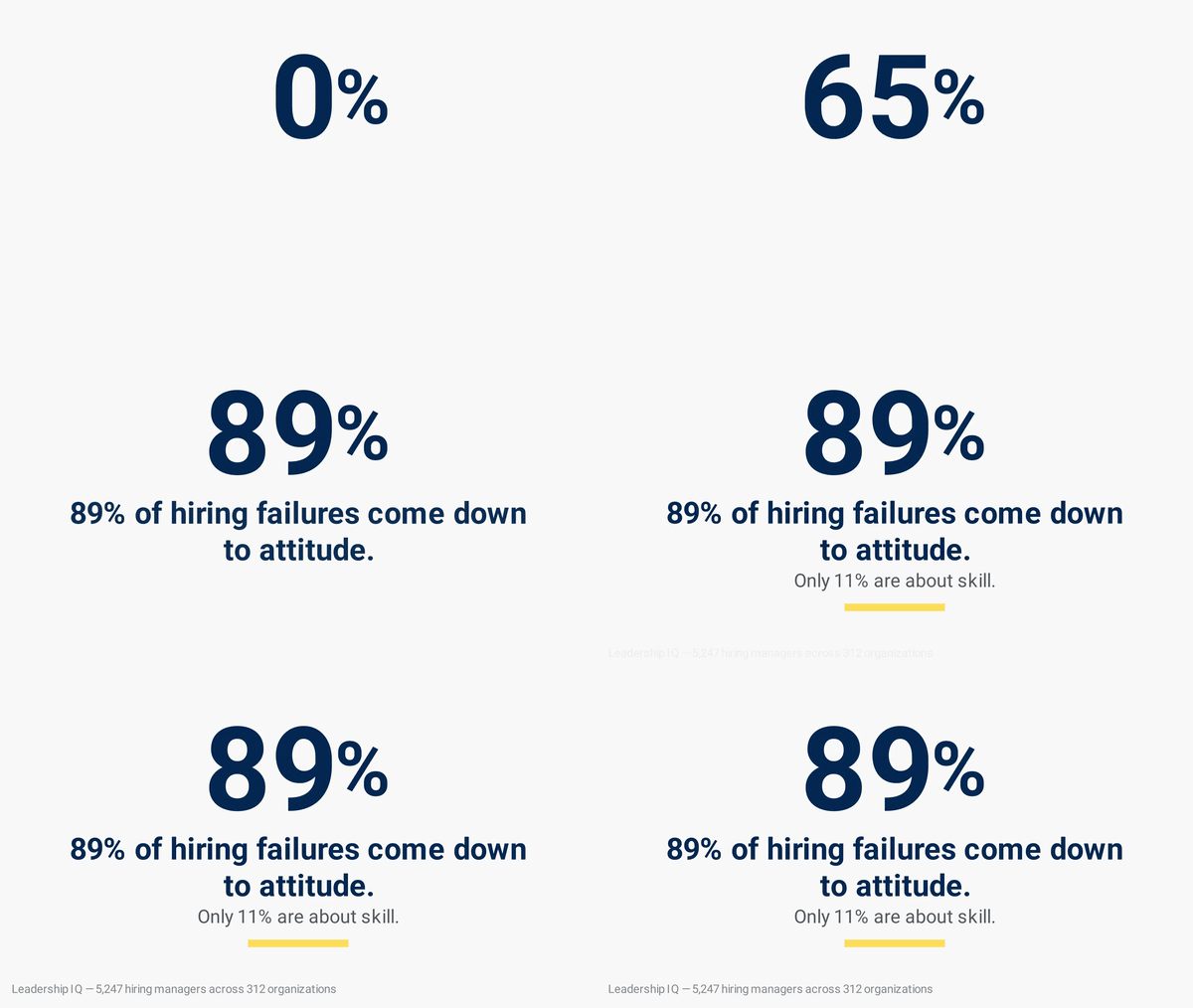
Here’s the breakdown they reported:
- 89% of new-hire failures came down to attitude. Motivation. Fit. Self-awareness. Coachability. The way the person showed up.
- 11% came down to a lack of technical skill.
The thing companies say they hire for is not the thing they actually hire for. They say “five years’ experience.” They mean “do I want to sit next to this person at 11pm during a launch.”
Sit with that ratio for a second. Because every job posting you have ever read leads with skill. Five years of this. Certified in that. Proficient in the other thing. That language describes 11% of the hiring decision. The other 89% — the part that actually decides who gets the offer — is almost never named on the page.
So when you see “qualified candidates only” and you check every box and you still don’t get the call, you’re not going crazy. You’re answering the question on the posting. They’re scoring the question they didn’t write down.
What “Attitude” Actually Means
“Attitude” is a soft word for what’s actually a hard, specific thing. When Leadership IQ unpacked the 89%, four things kept showing up in the data: motivation (does this person want this work for the right reasons), coachability (can they take feedback without breaking), emotional intelligence (do they read the room), and temperament (do they fit the actual day-to-day).
All four trace back to one underlying capacity: self-knowledge.
And here’s where the data gets sharper. Tasha Eurich, the organizational psychologist, ran a separate research project for Harvard Business Review with more than 5,000 participants. She found that 95% of professionals believe they’re self-aware. Only 10–15% actually meet the criteria.
So you have an 89% hiring decision built on a trait that 85–90% of the workforce thinks they have and doesn’t. The candidate who walks in with real, articulated self-knowledge is not just a slightly better candidate. They are statistically rare. They are the 10–15% in a stack of pattern-matched lookalikes — and the hiring manager feels it the moment they sit down.
This is what hiring managers mean when they say things like “we just clicked” or “she was the one.” It isn’t chemistry. It’s signal. They are picking up on a candidate who knows exactly who they are and what they’re doing in the room — and they are picking that candidate over candidates who, on paper, look the same.
A Real Final-Round Pattern: The Two Maria Problem
Here’s a composite from the kind of final-round we hear about constantly. Two candidates make it to the last round for a senior product manager role. Call them Maria A and Maria B. On paper they are identical: same MBA, same six years of experience, same shipped products on their resume.
Maria A is technically the stronger candidate. Her case study deliverable is tighter. Her metrics are sharper. The hiring panel agrees she is the more “qualified” of the two on every measurable axis. The 11%.
Maria B is asked, in the final round, why this role and why now. She answers in one breath. She says, in plain language, that she is hardwired to figure things out — to take an ambiguous brief and turn it into a clear plan — and that this role, which is rebuilding a broken roadmap, is exactly that work. She names how she operates with teammates. She names what she contributes that nobody asks her to. She does not hedge. She does not list adjectives.
Maria A answers the same question with a polished narrative about her career path and what she has learned from each role. It is well-rehearsed. It is also indistinguishable from the answer the panel heard from the previous three finalists.
Maria B gets the offer. The hiring manager later told her recruiter: “She just sounded like she knew exactly who she was.” That is the 89%. Maria A had the skill. Maria B had the signal.
How This Shows Up in the Final Round
If the 89% is the rule, the final round is where the rule breaks the tie.
By the time two candidates are sitting in a final interview, they’re both qualified. They both have the experience. The decision is no longer about credentials — it can’t be, because both finalists have them. The decision is about which candidate makes the hiring manager feel certain.
And the question that decision turns on is almost always the same one: Why this role, and why now?
Eight in ten hiring managers say candidates with genuine drive outperform candidates who are slightly more qualified but less clear about their motivation. Read that sentence carefully. Slightly more qualified. Less clear. The slightly-more-qualified candidate loses. The clearer candidate wins.
If you’ve ever been in a final round and walked out with a strong feeling and no offer, this is almost always what happened. You answered the qualification questions. You didn’t answer the 89% question. (We broke down the final-round dynamic in more detail in The Confidence Heuristic: How Hiring Managers Decide in 15 Minutes.)
What to Do This Week
Most career advice in 2026 is still advice for the 11%. Polish your resume. Add the right keywords. Practice your STAR stories. All of that is fine — and none of it touches the 89% that’s actually deciding the outcome.
The 89% requires something different. It requires you to be able to articulate, in plain language, what drives you, how you operate, and what you contribute — with enough certainty that a hiring manager hears you and stops looking at the rest of the stack.
That isn’t a confidence trick. You can’t fake your way to it, and rehearsing buzzwords makes it worse. It’s the byproduct of self-knowledge — the kind that 10–15% of professionals actually have. The good news: it isn’t a personality trait you were either born with or not. It’s the result of a specific framework, applied to yourself, in writing, until it’s clear enough to say in one breath.
Here is a five-step exercise you can run this week, before your next final round:
- Write your WHY in one sentence. Not your job. Not your title. The thing you are hardwired to do — the contribution that shows up across every role you’ve ever held. Most people need three drafts before this lands honestly.
- Write your HOW in one sentence. The way you operate when you’re at your best. Not adjectives — verbs. “I find the simplest version of the problem and put words on it” is a HOW. “I’m a hard worker” is not.
- Write your WHAT in one sentence. The specific contribution other people count on you for. The thing colleagues come to your desk for that nobody asked you to be the person for.
- Read all three out loud. If any of them sound like a LinkedIn headline, rewrite. Hiring managers can hear rehearsed language. They cannot hear self-knowledge in language that was built to be impressive.
- Practice the answer to “Why this role and why now” using only those three sentences. No biographical narrative. No career-path summary. Just: this is what I’m hardwired to do, this is how I do it, this is what people count on me for, and this role is exactly that work.
If you can do that exercise honestly in a notebook, you will walk into your next final round answering the 89% question — the one nobody else in the stack is answering — in a way that is impossible to fake and impossible to forget.
That is what the Career Clarity Pack does, in a structured framework, in one sitting. It walks you through the WHY.os — your hardwired driver, the way you operate, and what people count on you for — and gives you the language for the 89% the same way a good resume gives you the language for the 11%. One framework. One sitting. One clear answer to the question every hiring manager is silently asking and rarely writes down.
If you’ve been studying the 11% and losing on the 89%, the fix is not more polish. It’s clarity.
Get the $47 Career Clarity Pack →
Frequently Asked Questions
What did the Leadership IQ study actually find?
Leadership IQ surveyed 5,247 hiring managers across 312 organizations and tracked over 20,000 new hires. They found that 46% of new hires fail within 18 months — and when they do, 89% of those failures trace back to attitude (motivation, coachability, emotional intelligence, temperament), not technical skill. Skill accounts for only 11%.
Why does attitude matter more than skill in hiring?
Skill is easy to verify on a resume — and easy to train once a person is hired. Attitude is hard to assess in 30 minutes and almost impossible to train later. So hiring managers, often without saying it out loud, weight the harder-to-fix variable. The candidate with clear self-knowledge becomes the safer bet, even when their resume is slightly less polished.
How do hiring managers test for coachability?
They watch how you respond to pushback in the room. When an interviewer challenges your answer or surfaces a weak spot, do you defend, deflect, or absorb the feedback and respond clearly? Candidates who can name what they don’t know — without losing certainty about who they are — signal coachability without having to claim it.
What is the WHY.os and how does it relate to hiring?
The WHY.os is your operating system: your WHY (what drives you), your HOW (how you operate at your best), and your WHAT (what you contribute that people count on you for). All three are drawn from the 9 WHYs framework. Together they give you the precise, plain-language answer to the question every hiring manager is silently asking — and almost no candidate answers clearly.
How do I find my WHY?
The fastest evidence-based path is the WHY.os Discovery inside the Career Clarity Pack — a structured framework that surfaces your hardwired driver, your operating style, and your contribution in one sitting. It is research-backed and used by over 250,000 people. You can also start with the five-step exercise above as a free first pass.