
Updated May 2026 with peer-reviewed sources linked inline.
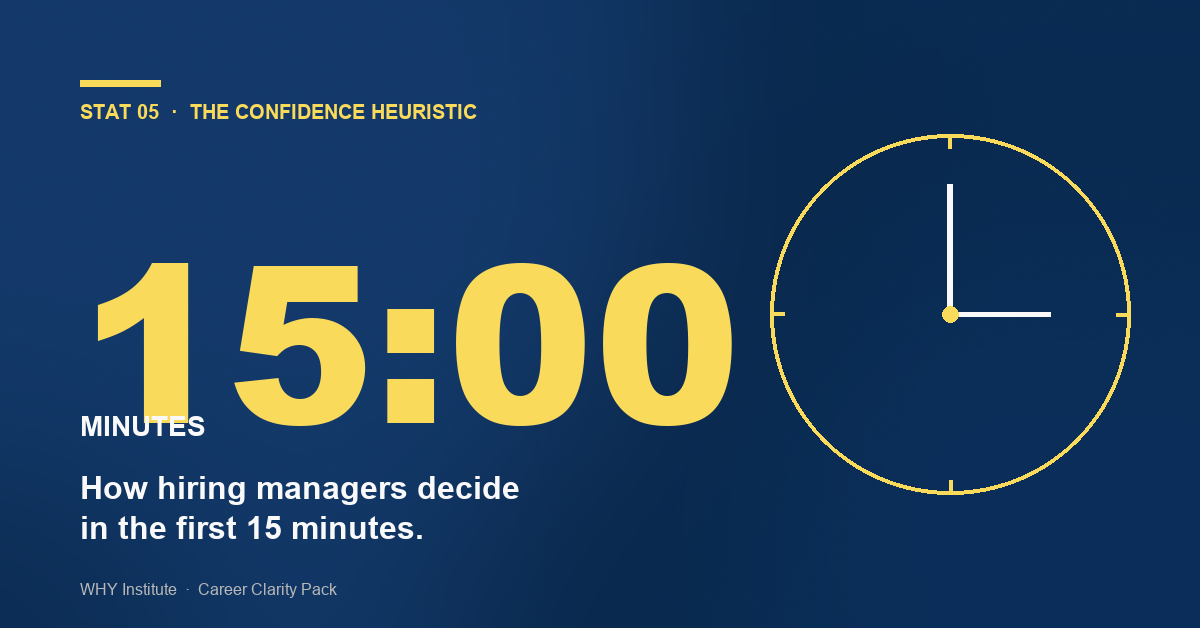
Six in ten interviewers have already decided about you before the halfway mark of your interview. Not minute thirty. Not the technical round. Minute fifteen.
That number comes from a peer-reviewed study by Frieder, Van Iddekinge, and Raymark (2016) — 166 interviewers evaluating 691 real candidates, published in the Journal of Occupational and Organizational Psychology. The breakdown is sharper than the headline:
- 4.9% of interviewers reach a decision within the first minute.
- 25.5% have decided within the first five minutes.
- 59.9% — six in ten — have decided by minute fifteen.

Most of the candidates in that study were still answering their second or third question when the person across the desk had already made up their mind. Whatever you say about who you are inside those fifteen minutes is what gets graded. The rest of the interview is the hiring manager looking for evidence to confirm what they already think.
The Stat Career Coaches Get Wrong
You have probably heard a different version of this number. The “seven-second first impression.” The “ninety-second decision.” Those numbers get repeated in every LinkedIn post, every interview-prep article, every TikTok career coach reel.
The seven-second number does not trace to a peer-reviewed interview study. It traces to social-perception research from the 1990s — Ambady and Rosenthal’s “thin slice” work — that was about classroom evaluations of teachers, not interview decisions for jobs. Over twenty years it got generalized, then over-generalized, then converted into clickbait. The ninety-second number has a similar problem. Neither one survives a citation check.
The Frieder, Van Iddekinge, and Raymark data does. It is the cleanest peer-reviewed measurement we have of when actual hiring interviewers reach a decision in actual interviews. And the answer it gives is not seven seconds. It is fifteen minutes.
That distinction matters because it changes what you can do about it. Seven seconds is a verdict. Fifteen minutes is a conversation. Fifteen minutes is enough time to say something true about who you are. Most candidates do not. (Related reading: what 5,247 hiring managers said they actually screen for.)
What Actually Decides It in Minute 15
If the decision is made before the technical round, before the deep-dive questions, before the case study — then it isn’t being made on competence. It is being made on something else. Researchers have a name for it.
It is called the confidence heuristic. In a series of three experiments published in the Journal of Experimental Psychology: General in 2018, Pulford and colleagues showed that when two people communicate, the one who sounds more certain wins — and that listeners use certainty as a shortcut for accuracy. The effect held in face-to-face conversations and in computer-mediated ones, which means it isn’t body language doing the work. It is the verbal expression of certainty itself. The candidate who sounds sure of who they are is read as the candidate who knows more.
The Pulford finding is not just an interview phenomenon. Stanford Graduate School of Business research has examined the same pattern from a different angle: how brittle first impressions are once formed, and how confidence — not competence — drives whether the impression sticks. Jerker Denrell’s work at Stanford GSB shows that once a hiring manager has read a candidate as uncertain, that read is unusually hard to reverse — there is rarely a second chance to clarify it inside the same interview.
The interview is not a competence test. It is a confidence test — and most of what’s being graded happens before the competence questions even start.
That is the brutal version of the answer. The interview is not measuring who can do the job. It is measuring who can talk about doing the job without flinching. And by minute fifteen, the hiring manager has already decided whether you can.
The Difference Between Confidence and Certainty
This is where most career advice gets dangerous. The advice industry hears “candidates with confidence win” and converts it into performance — power poses, eye contact drills, vocal warm-ups, the firm handshake. All of that lives on the surface. None of it survives fifteen minutes of an interviewer paying close attention.
Performed confidence and grounded certainty are not the same thing. They sound different on contact. Performed confidence is loud and slightly forced — the candidate is auditioning. Grounded certainty is quieter — the candidate is already at home in who they are. The interviewer cannot always tell you which one is which, but they can feel it. Selection-interview research published in the Journal of Business and Psychology consistently shows the same pattern: candidates who register as authentic — not rehearsed — are rated higher in the interview and perform better on the job afterward. Authenticity tracks reality. Performance does not.
The reason is mechanical, not mystical. Certainty is hardwired. It comes from knowing the thing about yourself that has been true since you were a kid — the way you process the world, the reason you do the work the way you do it, the signal that runs underneath every choice you’ve ever made. You don’t manufacture that in a coaching session. You uncover it. And once it’s named, it’s stable. It doesn’t shake under pressure. That is what an interviewer is reading in the first fifteen minutes — whether the person across from them is operating from something solid, or assembling an answer in real time.
This is the lane the WHY framework lives in. A WHY is not a polished story. It is the underlying driver — one of nine — that has been running you the whole time. Once you know which one it is and how it expresses itself, the certainty isn’t performance. It’s recognition.
How to Sound Certain Without Sounding Rehearsed
Practical things you can do, knowing what the research actually says — but only after the underneath part is in place. None of these tactics work unless you have the self-knowledge to anchor them.
- Lead with why, not where. When the interviewer asks “tell me about yourself,” most candidates start chronologically — school, first job, second job, here. That is the language of credentials. Replace the chronology with a one-sentence statement of why you do the work the way you do it, then let the chronology serve the why. The hiring manager is grading whether you have a center. Show them the center first.
- Cut the qualifiers. “I think I’m pretty good at…” “I sort of see myself as…” “I feel like maybe I…” Hedging language is the verbal opposite of certainty. The Pulford research is specifically about verbal expressions of confidence. Every “I think” you remove makes the room read you as more sure.
- Answer “why this role” the way the recruiter is actually asking it. The question is not “do you like the job description.” It is “do you know why this work, specifically, sits inside who you are.” Most candidates answer the first question. The candidate who answers the second one is the one the room remembers in minute fifteen.
- Stop sounding like a candidate. The candidate voice — modest, qualifying, eager to please — is the voice of a person hoping to be chosen. The voice that wins the room is the voice of a person who has already made the decision about who they are, and is now describing it. The shift is subtle. It is also the entire signal.
None of these tactics are about volume or polish. They are about source. You can rehearse a confident answer, and an experienced interviewer will hear the rehearsal. You cannot rehearse certainty about who you are. That has to actually be there.
The One Thing the First Fifteen Minutes Is Really Grading
Strip everything else away and the question the hiring manager is asking in those first fifteen minutes is one question: does this person know who they are?
Not what they did. Not where they went to school. Not how many years they have. Whether they know themselves clearly enough to describe themselves without flinching, in their own language, with conviction. That is the signal hiring managers are filtering on, even when they cannot tell you that is what they are doing. The peer-reviewed research is unambiguous about it. The candidates who walk in with that signal — grounded, articulate, certain — are the ones who walk out with offers.
The reason most candidates can’t do this isn’t talent or preparation. It is that nobody has ever taught them to articulate what is already true. Their resume is built. Their LinkedIn is optimized. Their interview answers are rehearsed. But the question underneath all of it — who am I, and why do I do the work the way I do it — has never been answered in language they can use in a room.
That is exactly the gap the WHY.os closes. It is not a personality test. It is a system that names the three layers of how you operate — your core driver, the way you bring it into the world, and the impact people feel from being around you. It produces the language a hiring manager hears in minute fifteen and remembers in minute fifteen-thousand. Not a story you wrote. A signal that was already there.
If you have ever walked out of a final round wondering what they saw — or didn’t see — in those first fifteen minutes, this is what was missing.
Frequently Asked Questions
How quickly do interviewers really decide?
Peer-reviewed research from Frieder, Van Iddekinge, and Raymark (2016) tracking 166 interviewers across 691 real candidates found 4.9% decide within minute one, 25.5% within five minutes, and 59.9% — nearly six in ten — by minute fifteen. The “seven-second” stat from viral career advice does not trace to interview research; it traces to 1990s thin-slice studies of classroom teachers.
What is the confidence heuristic?
The confidence heuristic is a documented pattern, tested in Journal of Experimental Psychology: General by Pulford et al. (2018), where listeners use a speaker’s certainty as a shortcut for accuracy. The person who sounds more sure gets read as the person who knows more — even when they don’t. In interviews, this means the candidate whose self-description carries certainty is graded as more competent, regardless of credentials.
How do I sound confident without being rehearsed?
Drop hedging language (“I think,” “I sort of,” “I feel like maybe”). Lead with why you do the work, not where you’ve worked. Answer “why this role” by naming the part of who you are that the work satisfies, not by describing the job. None of these tactics work without the self-knowledge underneath them — rehearsal is detectable inside fifteen minutes of an attentive interviewer.
What does authenticity look like in an interview?
Authenticity in an interview is the verbal version of self-knowledge. It sounds like a person describing something they already know, not a person reaching for an answer. Selection-interview research in the Journal of Business and Psychology consistently links authenticity ratings to higher interview scores AND higher post-hire job performance. It tracks reality; performed confidence does not.
How does the WHY.os help with interview confidence?
The WHY.os names the three hardwired layers of how you operate — your core driver, the way you bring it into the world, and the impact people feel from being around you. It gives you the language an interviewer hears as certainty in minute fifteen, because it isn’t a story you wrote — it’s a signal that was already there. The Career Clarity Pack ($47) is the fastest path to that language.